By Jay Paul Gumm
•
August 31, 2026
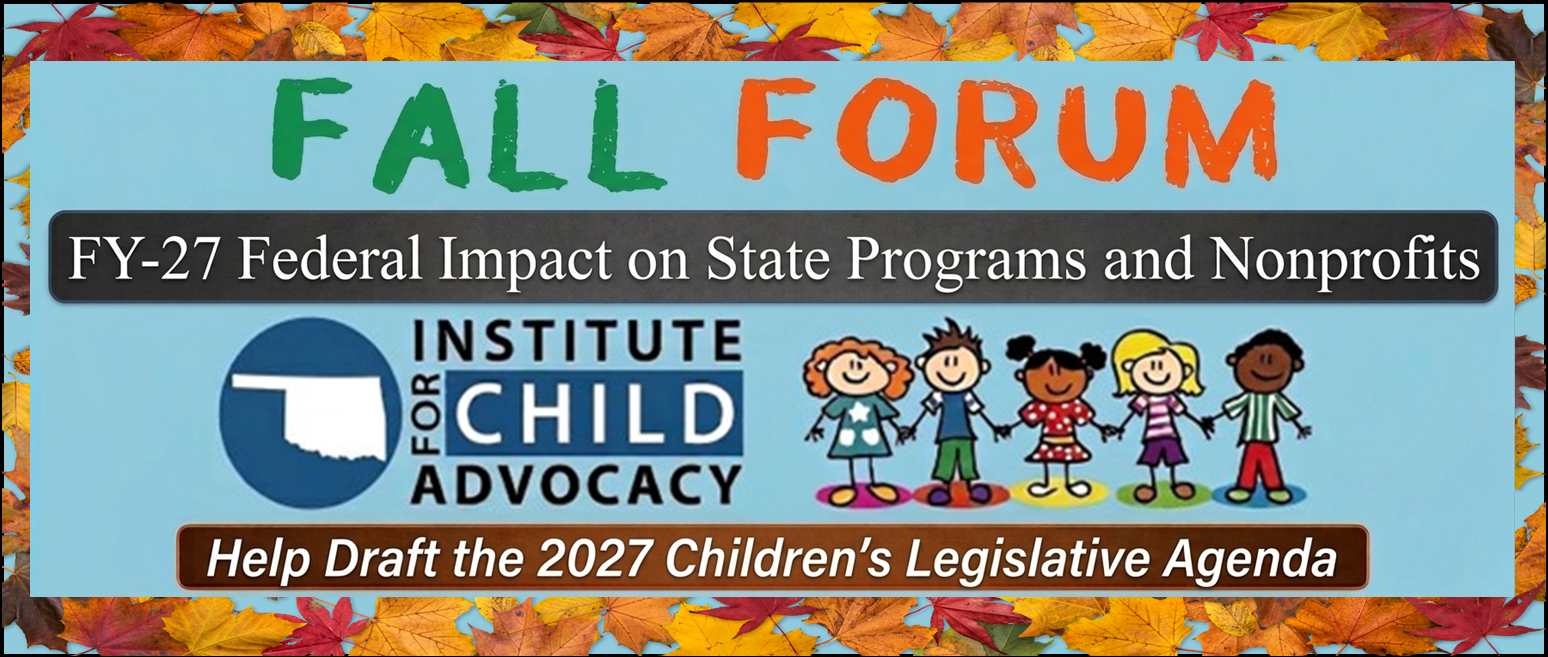
During its annual Fall Forum luncheon slated for Wednesday, Oct. 14, 2026, the Oklahoma Institute for Child Advocacy (OICA) will announce winners of 13 awards recognizing excellence in advocacy, public service, healthcare, education, and philanthropy for children. Nominations from members of the public are now being accepted for these awards, which can be submitted on the organization’s website at https://www.oica.org/awards . The 13 awards are: The Steven A. Novick Child Advocacy Award. The Laura Choate Resilience Award. The Jasmine and Melvin Moran “Kidizenship” Award. The Burnes/Lichtenstein Award for Excellence in Journalism. The H.E. “Gene” Rainbolt Corporate Citizen Award. The Ray & Pat Potts Community Leader Award. The Judy Eason McIntyre Inclusion Award. The Sandy Garrett Educator Award. The Jari Askins Justice for Children Award. The Jon Hansen Public Servant Award. The Dr. Dwight Sublett Healthcare Award. OICA’s Volunteer of the Year Award. The CEO’s Award in Child Advocacy. Steven A. Novick served as the legal counsel for the children who brought forth the “Terry D” lawsuit against the State of Oklahoma. The award is for recognizing an “unsung hero” in the area of child advocacy. Laura Choate has served as a lifelong advocate for Oklahoma children and was the first recipient of the Resilience Award. As a youth, Choate served as a plaintiff in the class-action lawsuit that resulted in dramatic changes to Oklahoma’s juvenile justice system and was used as a model by many other states to establish higher standards. The award is for someone who, like Laura, has overcome difficult circumstances in their youth to become an effective child advocate. The Kidizenship Award is OICA’s statewide award recognizing and rewarding excellence in youth philanthropy by and for Oklahomans under the age of 18. The award is named after Melvin and the late Jasmine Moran, philanthropists, best known as the founders of the Jasmine Moran Children’s Museum in Seminole, Oklahoma. H.E. “Gene” Rainbolt was a prominent figure in the Oklahoma banking industry, having founded BancFirst, the largest state-chartered bank in the state. A strong advocate of improving and diversifying the Oklahoma economy, Mr. Rainbolt worked long and hard to improve health, education, provide better access to capital, and develop Oklahoma’s infrastructure system. This award will recognize a business which has done significant work to help children outside their normal operations. The Burnes/Lichtenstein Award for Excellence in Journalism is named for Karen Burnes and Bill Lichtenstein, two of the reporters who helped uncover the scandal of child abuse under the Oklahoma Department of Human Services in the early 1980s. Their reporting was part of the effort that led to wholesale changes to state’s juvenile justice system and the creation of OICA as an independent watchdog organization outside of state government. The Ray & Pat Potts Community Leader Award was named for the co-founders of The Potts Family Foundation, the late Ray Potts and his wife, Pat, who passed on August 20, 2025. Pat also co-founded the Oklahoma Center for Nonprofits where she served as president and CEO for 20 years. Pat’s focus was always on leveraging resources “to address root causes and build the human potential of the people of our state one child and one organization at a time.” The award will be presented to an Oklahoman in the business world who outside of their profession has done something exceptional to benefit children. A breast cancer survivor who grew up in segregated north Tulsa, Judy Eason McIntyre built a career in social work, served on the Tulsa Public Schools Board, and spent 10 years in the Oklahoma Legislature, serving as a state representative, then a state senator. Through that time, she helped break down race barriers and elevate difficult conversations for the betterment of generations to come. This award will recognize someone who has helped break down racial barriers to benefit youth. The Honorable Sandy Garrett, a lifelong educator, was first elected state Superintendent for Public Instruction in 1990, and again in 1994, 1998, 2002, and 2006. Garrett was the first woman to hold the office of Superintendent and is the only woman to hold a statewide office for five consecutive terms. Through her work, early childhood education was significantly expanded statewide. This award will be presented to an educator who has done something significant for the benefit of Oklahoma’s children. The Jari Askins Justice for Children Award is named for The Honorable Jari Askins, who served with distinction in all three branches of Oklahoma state government and, most recently, as the interim president of Cameron University in Lawton. The Askins Award is awarded to someone in the state’s legal community who has done outstanding work in the courts on behalf of Oklahoma’s children. Jon Hansen began his 26-year career with the Oklahoma City Fire Department in November 1973, eventually becoming an Assistant Fire Chief, where he served as the department’s Public Information Officer during the OKC Bombing. Following this, he became the Executive Director for the Council on Firefighter Training (COFT), working with volunteer fire departments across the state prior to his death. This award recognizes a public servant – law enforcement, fire service, or emergency medical service – who has gone beyond in some way to help a child or children. Dr. Dwight Sublett was the President of the American Academy of Pediatrics - Oklahoma Chapter for several years. During his life, he was an extremely accomplished physician working through the pandemic to protect the health of Oklahomans. He received a multitude of distinguished awards, but the highlight of his career was the children he attended, and the countless lives he touched. This award will go to a member of the healthcare field, individual or organization, who has improved the health of the state’s children through an exceptional act or cause. The OICA Volunteer of the Year Award will go to an individual who has given of their time, talents, and treasures to help ensure that OICA is able to perform the mission set out for it by its founders more than 40 years ago: “Creating awareness, taking action, and supporting policy to improve the health, safety, and well-being of Oklahoma’s children.” The CEO’s Award in Child Advocacy will go to a child advocate whose work does not fit into any category for which specific recognition is given. The award recognizes the tireless efforts of individuals in virtually every profession and area of volunteer service who struggle to make a positive difference in the lives of children. “These awards will allow us to further express our gratitude to those working in different sectors, and who are positively impacting children through their efforts,” said Joe Dorman, chief executive officer of OICA. “We hope this recognition will bring attention to the wonderful advocates who are selected and hopefully provide further encouragement for Oklahomans to do good acts which benefit our children.” Dorman stated that anyone is eligible to nominate a qualifying Oklahoman for any of the awards. “All one has to do is go to our website at oica.org and fill out the nomination form for a suitable nominee,” he said. “Each year, we receive a tremendous group of nominees who embody what is best about Oklahoma. I look forward to seeing the suggestions and presenting those to the OICA awards committee who will determine the recipients.” Nominations will close at 5 p.m. on Friday, Sept. 11. Award winners will be determined by OICA’s Board of Directors and announced at the luncheon on Wednesday, Oct. 14 during OICA’s annual Fall Forum, a conference where advocates and state officials come together to learn how to be a better champion for children. The conference was established to help develop the annual “Children’s Legislative Agenda” to guide OICA’s policy work at the State Capitol. You can find more details relating to the conference at the OICA website.